

Measuring AI's Business Impact

26
Feb
Measuring AI's Business Impact: Beyond the Hype to Quantifiable Results
The Measurement Imperative
In a recent boardroom discussion at a Fortune 500 retailer, the Chief Digital Officer presented an ambitious AI implementation roadmap. When the CFO inquired about expected returns, silence filled the room. "We know AI is transformative," the CDO finally responded, "but we haven't established concrete metrics yet." This scenario, unfortunately, is not uncommon.
According to McKinsey's 2024 Global Survey on AI, while 72% of organizations report AI investments, only 31% can demonstrate measurable returns on these investments. This measurement gap represents perhaps the most significant barrier to AI's continued enterprise adoption. As Thomas Davenport, distinguished professor at Babson College, notes: "The difference between AI experiments and AI transformation is systematic measurement."
The Measurement Framework Challenge
Measuring AI's business impact presents unique challenges compared to traditional technology implementations. AI systems often influence multiple aspects of an organization simultaneously, creating both direct effects (e.g., cost reduction) and indirect benefits (e.g., improved decision quality). Furthermore, as these systems learn and improve over time, their impact profiles evolve, requiring dynamic rather than static measurement approaches.
Consider the experience of a global pharmaceutical company that implemented a machine learning system to optimize clinical trial site selection. Initial measurements focused solely on reduced time-to-recruitment. However, this narrow metric missed significant downstream impacts: improved protocol adherence, higher data quality, and ultimately, faster regulatory submissions. By expanding their measurement framework, they documented a 32% improvement in overall trial efficiency—substantially higher than the 14% initially reported.
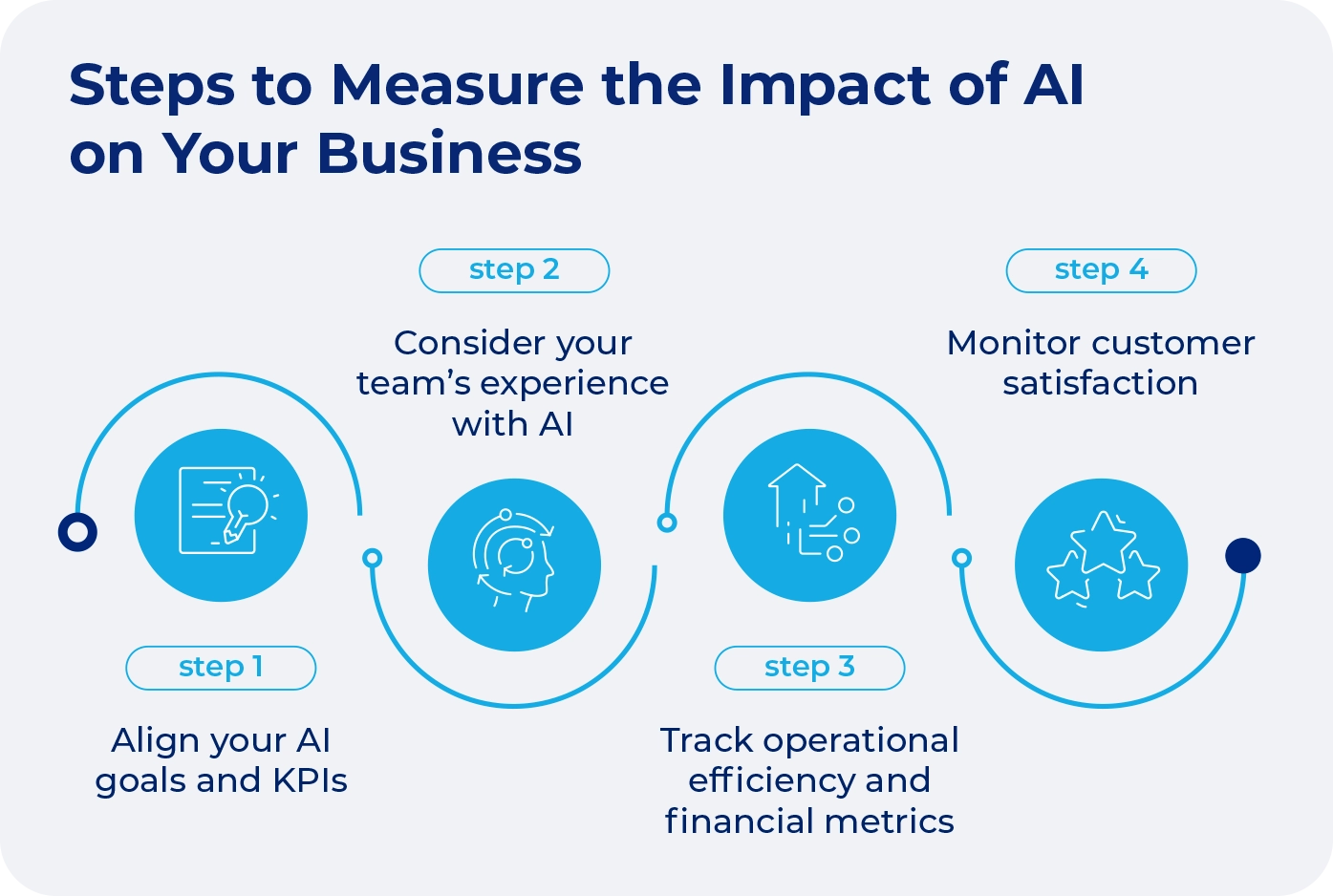
Establishing a Multidimensional Measurement System
Effective AI impact measurement requires a multidimensional approach that captures both quantitative outcomes and qualitative transformations. The most comprehensive frameworks typically address four critical dimensions:
1. Financial Impact: While seemingly straightforward, financial measurement must extend beyond immediate cost reduction to capture revenue enhancement, market expansion, and risk mitigation. A leading insurance provider initially calculated a $3.2M annual savings from their claims processing AI. However, after implementing a comprehensive measurement system, they identified an additional $8.7M in fraud prevention and $12.1M in improved customer retention attributable to faster, more accurate claims handling.
2. Operational Excellence: This dimension captures improvements in speed, accuracy, and consistency. Metrics might include reduced processing time, decreased error rates, or increased throughput. For operational metrics, establishing pre-implementation baselines is essential. As Daniel Kahneman has noted in his work on decision biases, organizations frequently underestimate pre-automation error rates, leading to artificially low measurements of AI impact.
3. Customer Experience: AI often significantly impacts customer interactions and satisfaction. Measurement should incorporate Net Promoter Scores, customer effort scores, retention rates, and sentiment analysis. One telecommunications provider found that while their AI chatbot implementation showed modest operational savings, the most significant impact appeared in a 28-point increase in transactional NPS scores and a 14% reduction in customer churn.
4. Employee Empowerment: Perhaps most overlooked are metrics related to employee experience and capability enhancement. These might include productivity improvements, job satisfaction, skill development, or time reallocation to higher-value activities. Microsoft's internal analysis of their AI assistance tools revealed that while direct time savings were modest (9.7%), employees reported a 31% reduction in cognitive load and a 26% increase in job satisfaction—factors ultimately linked to improved retention and performance.
The Time Dimension
Beyond these four dimensions lies a critical temporal component. AI implementations typically follow a non-linear impact curve. Initial results often underwhelm as systems learn and users adapt, followed by an acceleration phase as both the technology and organization evolve. A premature measurement can significantly understate eventual impact.
A global logistics company implemented an AI-driven route optimization system that showed a modest 6% efficiency improvement in the first quarter. Had they concluded their measurement there, they would have deemed the project a moderate success. However, by continuing measurement through month 18, they documented a 27% efficiency improvement as the system incorporated more historical data and operators developed increased trust in its recommendations.
Implementation: Beyond the Dashboard
Effective measurement goes beyond establishing metrics; it requires creating a measurement infrastructure. Organizations achieving the highest ROI from AI typically establish:
• Clear Baselines: Comprehensive pre-implementation measurement across all four dimensions, often requiring 3-6 months of data collection.
• Measurement Governance: A cross-functional team responsible for maintaining measurement integrity, including representatives from finance, operations, and data science.
• Learning Loops: Mechanisms to feed measurement insights back into AI system refinement and deployment strategies.
• Executive Dashboards: Visual representations that tell the complete impact story, not merely technical performance metrics.
Conclusion: Measurement as Strategic Advantage
In the current economic climate, organizations face increasing pressure to demonstrate returns on all technology investments. Those that establish robust measurement frameworks for AI initiatives gain a distinct advantage: the ability to identify and scale successful implementations while quickly redirecting or terminating underperforming projects.
As Andrew Ng, founder of deeplearning.ai, aptly observed: "The gap between AI leaders and laggards isn't primarily in algorithm sophistication but in measurement sophistication." Organizations that develop this measurement capability don't merely document AI's impact—they systematically amplify it, creating a virtuous cycle of implementation, measurement, refinement, and expanded adoption that delivers sustainable competitive advantage.